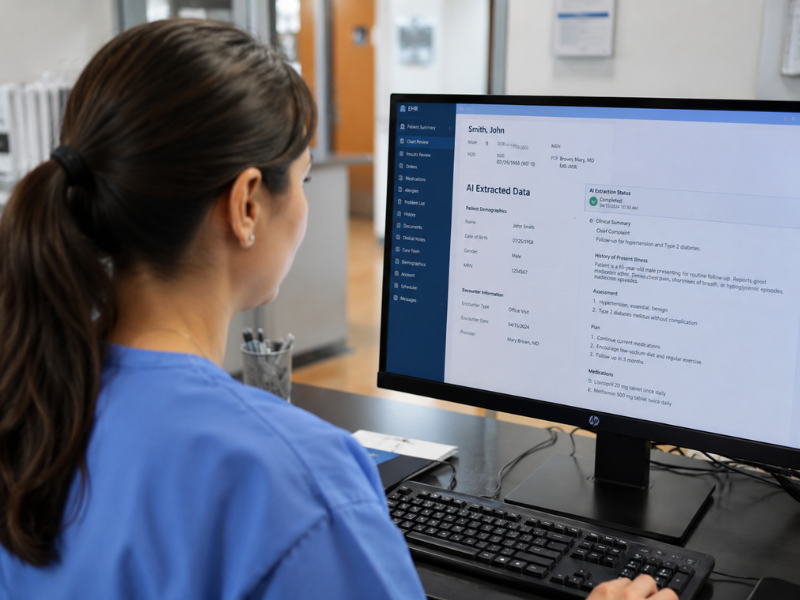
AI in healthcare applies technologies like machine learning and natural language processing to automate clinical and administrative workflows. It supports decision-making, processes large volumes of data, and extracts information from documents such as healthcare faxes to reduce manual data entry.
Explore how AI is used in healthcare, the tools and solutions providers rely on, the benefits and limitations, and why many workflows still depend on healthcare fax.
On This Page
What Is AI in Healthcare?
Artificial intelligence (AI) in healthcare improves patient care and operational efficiency by supporting clinical decisions, automating administrative work, and managing patient data at scale. It uses technologies that can recognize patterns, understand language, analyze medical images, and predict health risks, powering applications ranging from medical imaging and healthcare fax data extraction to document automation.
AI use in healthcare isn’t about replacing existing systems. Instead, it works alongside electronic health records (EHRs), imaging platforms, scheduling tools, and document workflows like fax and email to make everyday work faster, smarter, and more efficient.

How Is AI Used in Healthcare
AI adoption continues to accelerate across healthcare. In an annual survey published by the American Medical Association, the 2026 results show that 81% of physicians now use AI professionally (compared to 38% back in 2023). Separately, data compiled by TheAIDaily indicate that 75% of U.S. health systems now use at least one AI application, compared with 59% in 2024.
Here’s how that adoption breaks down in practice:
1. Clinical Documentation and Ambient Scribing
AI-powered scribes listen to patient visits and generate structured clinical notes in real time. Healthcare systems deploying these tools have reported reductions in documentation time of 40–45%, along with measurable drops in clinician burnout associated with after-hours charting.
2. Medical Imaging and Diagnostics
Radiology remains the most mature use case for regulated artificial intelligence. Algorithms assist in detecting tumors, fractures, and cardiovascular abnormalities, often matching or exceeding clinician sensitivity in studies covering mammography, CT, and chest X-ray analysis. The majority of AI-enabled medical devices cleared by regulators to date are concentrated in imaging.
3. Predictive Analytics and Risk Scoring
Hospitals use predictive models embedded in EHRs to flag patients at risk of sepsis, readmission, or clinical deterioration before symptoms become acute. The majority of U.S. acute-care hospitals now run some form of predictive AI integrated into their EHR.
4. Administrative Automation
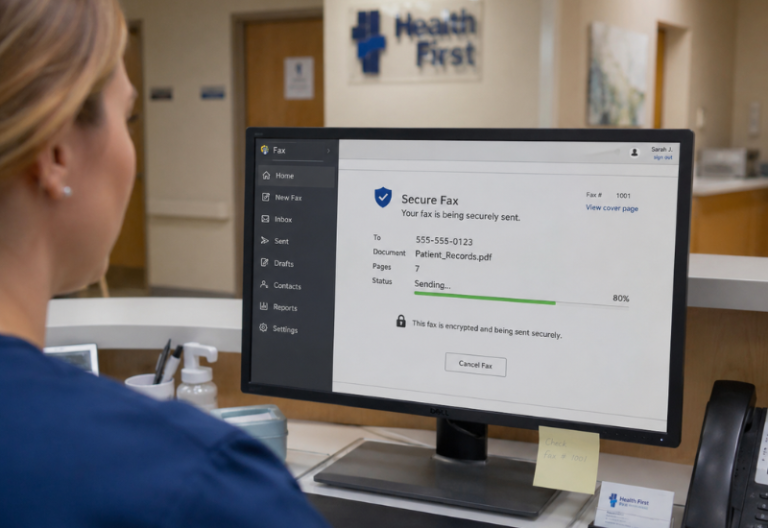
AI is helping automate prior authorization, claims processing, scheduling, and referral management, reducing manual workload and high-volume paperwork. Since referrals and authorization forms are still widely exchanged via fax, AI-powered solutions use Fax OCR and document recognition to automatically extract and route data without replacing existing workflows.
Also Read:
How AI-Powered Faxing is Solving the Biggest Headaches in Healthcare and Compliance
5. Virtual Care and Remote Monitoring
Healthcare providers use machine learning models to analyze data from wearables and connected devices. This modern approach helps support early detection of clinical deterioration in remote and home-based care settings, helping health systems improve remote monitoring for chronic disease management.
AI Solutions in Healthcare
The table below summarizes the main categories of AI tools used by healthcare organizations and the key challenges they help solve.
Category | Example Use Case | Primary Value |
Ambient documentation / AI scribes | Auto-generated clinical notes from patient encounters | Reduced charting time, lower burnout |
Imaging AI | Detecting tumors, fractures, strokes in scans | Faster, more consistent diagnostic review |
Predictive EHR analytics | Sepsis and readmission risk scoring | Earlier clinical intervention |
Extracting and routing data from faxed referrals, labs, and prior auth forms while keeping HIPAA-compliant, universally accepted fax delivery | Less manual entry, fewer transcription errors, no loss of compatibility across EHRs | |
Administrative automation | Prior authorization, claims, scheduling | Lower administrative cost per case |
Virtual care AI | Remote patient monitoring, triage chatbots | Earlier detection, reduced readmissions |

Benefits of AI in Healthcare
The return on AI investment in healthcare is becoming easier to quantify as deployments mature beyond the pilot stage:
- Lower documentation burden: AI scribes reduce charting time by roughly 40–45% in institutions that use them at scale.
- Improved diagnostic consistency: Imaging AI has matched or exceeded clinician sensitivity across several modalities in peer-reviewed studies.
- Measurable business value: Organizations report meaningful returns within roughly a year of deployment for well-scoped use cases such as documentation and imaging triage.
- Reduced administrative costs: AI-assisted EHR retrieval and document processing have cut record search and intake time by more than half in some settings.
- Workload optimization: By automating repetitive documentation, data entry, and online fax workflows, AI gives clinical staff more time to focus on patient care instead of paperwork.
Challenges and Risks of AI Use in Healthcare
The use of AI in healthcare isn’t risk-free, and the obstacles are consistent across industry research:
- Algorithmic bias and generalization: Models trained on non-representative patient populations can underperform for the groups least represented in training data.
- Liability and accountability: When an AI recommendation contributes to an adverse outcome, responsibility between the clinician, hospital, and vendor is often unclear under current regulations.
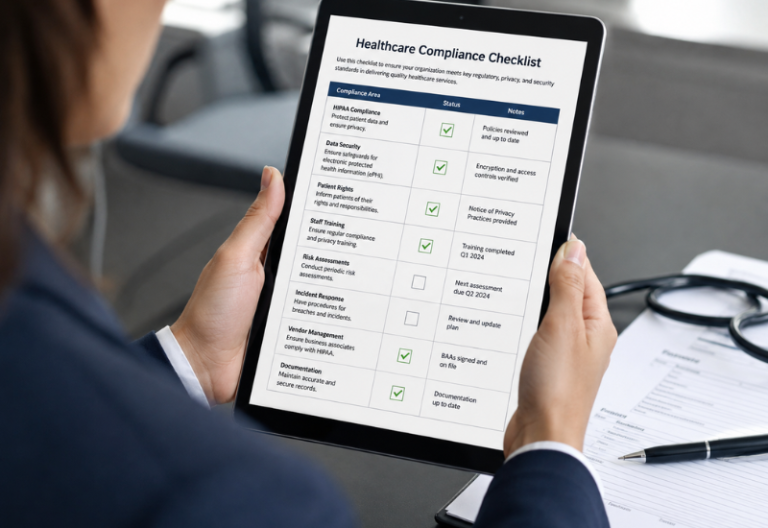
- Privacy and security: AI tools that process protected health information (PHI) must meet HIPAA, PHIPA, and similar regulatory requirements, particularly when data moves between systems.
Key Takeaway
AI in healthcare delivers the greatest value when applied to documentation, imaging triage, and administrative workflows, where data is structured or can be standardized. Clinical diagnosis still requires human oversight, and fully autonomous AI remains uncommon.

The Future of AI in Healthcare
As healthcare organizations are moving from testing AI to integrating it into everyday workflows, here’s what comes next:
AI becomes part of everyday healthcare tools
Instead of using AI as a standalone tool, it will be built directly into healthcare systems, like EHRs, EMRs, and other software. Just as spell check is now a standard feature in word processors, many AI capabilities will run in the background as part of everyday workflows.
Rules and regulations become clearer
As AI adoption grows, expect more guidance from regulators on how healthcare organizations can use AI safely and responsibly. States will also continue introducing new laws that shape how AI is developed and used in healthcare.
Administrative AI keeps evolving
Healthcare organizations are seeing the biggest gains from AI in administrative work. Expect continued growth in documentation, patient intake, prior authorization, document processing, and online fax workflows, significantly reducing manual work and speeding up routine tasks.
Frequently Asked Questions
How is AI used in healthcare today?
Artificial intelligence is used to help healthcare providers make faster decisions and reduce administrative work. Common uses include medical documentation, imaging analysis, predictive risk assessment, prior authorization, claims processing, remote patient monitoring, and document automation, including healthcare fax processing.
What are the main benefits of AI in healthcare?
AI helps healthcare organizations save time, reduce paperwork, improve diagnostic accuracy, and identify high-risk patients earlier. It also automates repetitive tasks.
What is the use of AI for data extraction?
It refers to using OCR and AI-based document recognition to convert faxed referrals, lab results, or authorization forms into structured, searchable data. Doing so reduces manual entry while preserving the HIPAA-friendly, universally compatible nature of fax communication.
Is AI replacing healthcare professionals?
No. AI is meant to help healthcare professionals do their jobs, not replace them. It assists with tasks such as recording patient information, analyzing medical images, and assessing risk. Still, clinicians must review AI-generated recommendations and make the final decisions about patient care.
A Practical Way to Bring AI Into Healthcare
AI delivers the fastest and most measurable results when applied to high-volume, well-defined tasks. HIPAA-compliant fax in healthcare is one of the clearest examples.
Referrals, lab orders, and prior authorizations continue to be sent by fax because it is secure, compliant, and works with virtually any EHR without complex integrations. By combining fax capabilities with AI, OCR, and data extraction, healthcare organizations can better streamline existing workflows.
If you’re looking for a practical place to begin, start by modernizing your fax process with iFax and transform one of healthcare’s oldest workflows into one of its smartest.