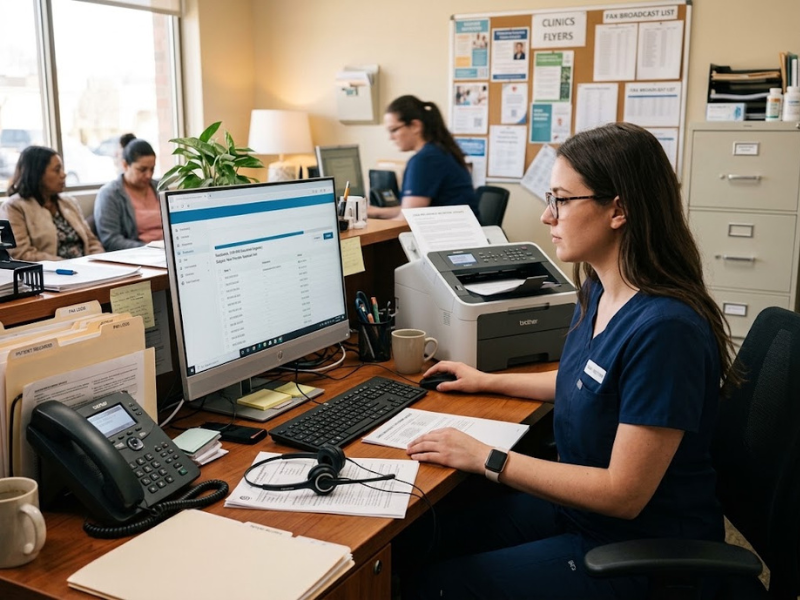
Quick Answer: Fax broadcasting (also called broadcast fax) means sending a single fax document to multiple recipients at the same time, instead of sending it individually.
Businesses use broadcast faxing to send notices, forms, campaigns, or company announcements to a large contact list, including but not limited to customers, vendors, business associates, and healthcare partners. It removes the need to manually send and resend the same document, one number at a time.
The sections below cover what fax broadcasting is, how it works, common business use cases, and what to look for when choosing the best fax broadcasting service.
Table of Contents
What Is Fax Broadcasting and How Does It Work?
Online fax broadcasting works by combining three core components:
- A document. This is the fax content you want to distribute (a memo, notice, form, price update, compliance alert, etc.)
- A recipient list. The fax numbers of everyone who should receive the document.
- A fax broadcasting platform. The cloud service that manages transmission, retries, delivery tracking, and confirmation.
The general workflow looks like this:
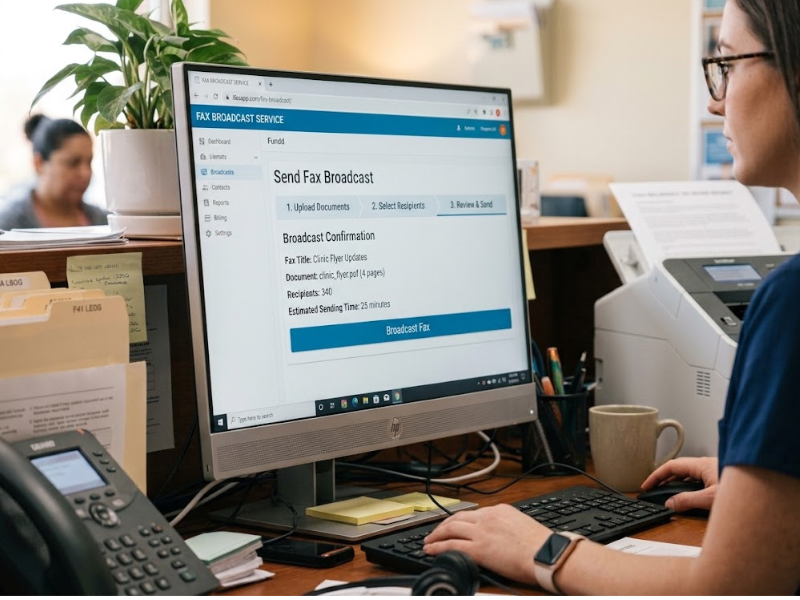
- The document gets uploaded to the fax broadcasting software, typically as a PDF, Word file, or scanned image.
- Instead of one or two recipients, you select multiple contacts from either an existing group or an imported list, often a CSV file or a spreadsheet.
- The platform queues the transmissions and sends the fax to each number, usually in parallel across multiple virtual lines rather than sequentially.
- The platform also displays the status of each fax for every recipient, making it easy to see which faxes were delivered successfully, which failed, and which need to be resent.
- Reports and logs are generated, which matter for organizations that need an audit trail of what was sent and when.
The entire process takes place through cloud infrastructure rather than physical machines. Businesses can launch a broadcast fax from a computer, phone, or web application.

Why Businesses Still Use Fax Broadcasting in 2026
It’s fair to ask why any business would broadcast information via fax when there is email and instant messaging. The answer usually comes down to three factors:
Reliability and legal weight
In industries like healthcare, insurance, and legal services, fax remains a recognized and often required method for transmitting official documents. A fax broadcast can satisfy that requirement while still scaling to large recipient lists.
Reaching fax-dependent partners
Many external partners (i.e., hospitals, clinics, pharmacies, courts, agencies, and other businesses) still operate primarily through fax. If your recipients are on fax-based systems, broadcasting is often the most direct way to reach them all at once.
Compliance-friendly delivery confirmation
Unlike email, which can land in spam folders or go unnoticed, fax delivery is typically confirmed at the transmission level, giving organizations a clearer record that a document was actually delivered.
Common Use Cases of Fax Broadcasting Services
Businesses lean on fax broadcasting services for a range of recurring, high-volume communication needs, including:
- Healthcare notices — sending policy updates, referral information, or public health notices to multiple clinics or provider networks at once
- Legal and compliance announcements — distributing regulatory updates or required disclosures to a large list of contacts.
- Financial and insurance updates — sending rate changes, form updates, or account notices to branch offices or partner agents.
- Franchise and multi-location communications — pushing the same operational memo to dozens or hundreds of locations simultaneously.
- Vendor and supplier alerts — notifying a distribution network about order changes, recalls, or scheduling updates.
- Government and public sector notices — reaching agencies or departments that still rely on fax as an official channel.
In each of these cases, the value of fax broadcasting isn’t nostalgia for old technology. It’s the ability to effectively reach fax-dependent recipients at scale without manual repetition or document inconsistencies.
Fax Broadcasting vs. Email and Bulk Text Messaging
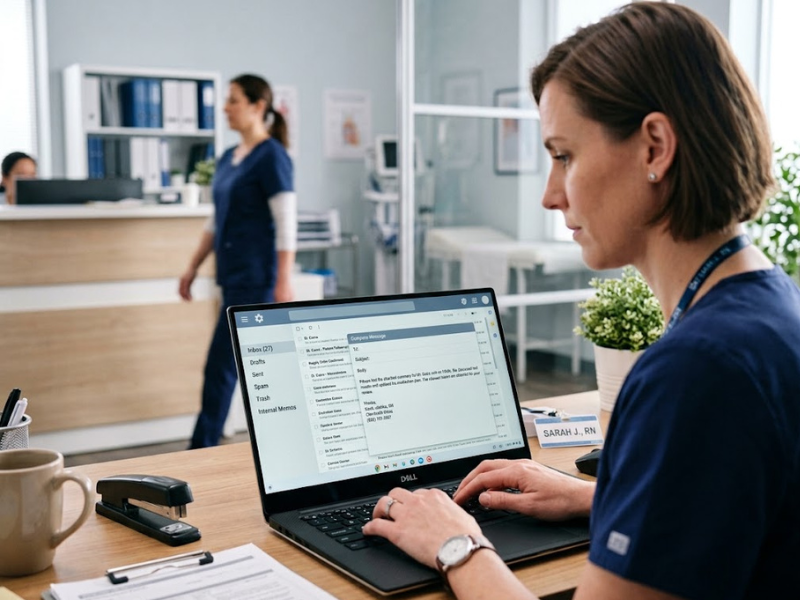
Email blasts and bulk SMS are often faster and cheaper to send, so it’s worth asking why a business would choose broadcast faxing over the two.
| Fax Broadcasting | Email Blast | Bulk SMS |
Delivery confirmation | Confirmed at transmission level | Often lands in spam/promotions | Depends on carrier and phone status |
Reaches fax-only institutions | Yes | No | No |
Legal/regulatory standing | Often explicitly accepted | Rarely sufficient alone | Rarely sufficient alone |
Document fidelity | Sent as-is, unaltered | Reformatted into email body | Trimmed to fit message limits |
Best for | Official, compliance-sensitive documents | Marketing, informal updates | Time-sensitive consumer alerts |
Cost per send | Low-moderate | Very low | Low |
- Compliance doesn’t bend for convenience. If a workflow requires fax, a faster channel doesn’t satisfy the requirement.
- No inbox, no problem. A fax doesn’t need to be opened to be delivered. It just needs a line on the other end.
- Confirmation beats hope. “Sent” isn’t the same as “received.” Fax broadcasting gives you proof of the latter.
- Fax-only doesn’t mean outdated. Clinics, courts, and agencies that still run on fax won’t respond to an email address.
- What you send is what they get. No clipped subject lines, no broken formatting. The document arrives exactly as sent.
Email and SMS aren’t going anywhere, and they shouldn’t. They’re fast, low-cost, and ideal for everyday outreach. Fax broadcasting works best alongside them, stepping in to reach fax-based institutions, deliver regulated documents, and provide businesses with confirmed proof of delivery when it counts.
How to Choose the Best Online Fax Broadcasting Service
Choosing from multiple fax broadcasting services can get overwhelming, especially when providers offer different features, pricing, security standards, and sending capabilities. Before choosing a provider, consider the following key factors:
Reliability and delivery tracking
The platform should provide clear confirmation of which faxes were delivered successfully, along with retry handling for failed transmissions.
Security
Since broadcasts often involve sensitive business, financial, health, or medical records, look for encryption in transit and at rest, along with administrative controls on who can send and access documents.
List management
A strong fax broadcasting service should make it simple to import, organize, and update large recipient lists without manual re-entry.
Scalability
Whether you’re sending to 100 recipients or 10,000, the platform should handle high faxing volume smoothly.
Ease of use across teams
Since fax broadcasts are often initiated by administrative or operations staff rather than IT, the platform should be straightforward enough for anyone to use.
Integration support
Many organizations benefit from connecting fax broadcasting into existing workflows (i.e., EHRs, EMRs, CRMs) rather than treating it as a standalone tool.
Broadcast fax services like iFax are built around this cloud-first model, giving businesses a way to manage broadcasts alongside everyday fax sending and receiving. For organizations already using online fax, that kind of consolidated approach can simplify how broadcasts fit into the broader communication workflow.
Key Takeaway
Fax broadcasting offers a practical solution for any business that needs to reliably, securely, and at scale reach a large group of fax-dependent contacts. As fax infrastructure has moved to the cloud, broadcasting has become far more accessible. For businesses evaluating a fax broadcasting service, the priorities should be the same as those for any critical business communication tool — ease of use, reliability, security, compliance, and scalability.
Choosing the Right Fax Broadcasting Partner
The technology behind fax broadcasting is already well established. The real difference between providers comes down to reliability, security, compliance, and ease of running the platform day-to-day. What it means is picking a platform that can actually keep up, providing dependable delivery, solid security, and room to scale as your recipient lists grow.
That’s where iFax steps in with its compliance-ready broadcast fax platform, featuring tools designed to simplify workflows and provide better visibility into every transmission.
Learn more about how fax broadcasting for business works.
Contact sales or request a demo.